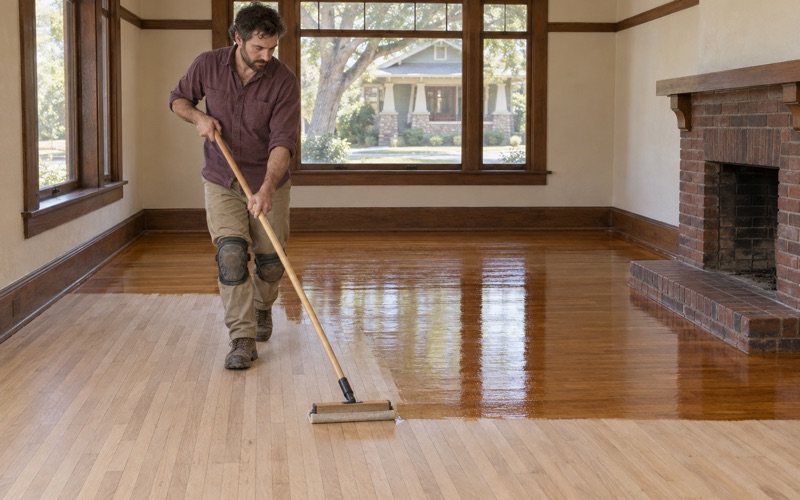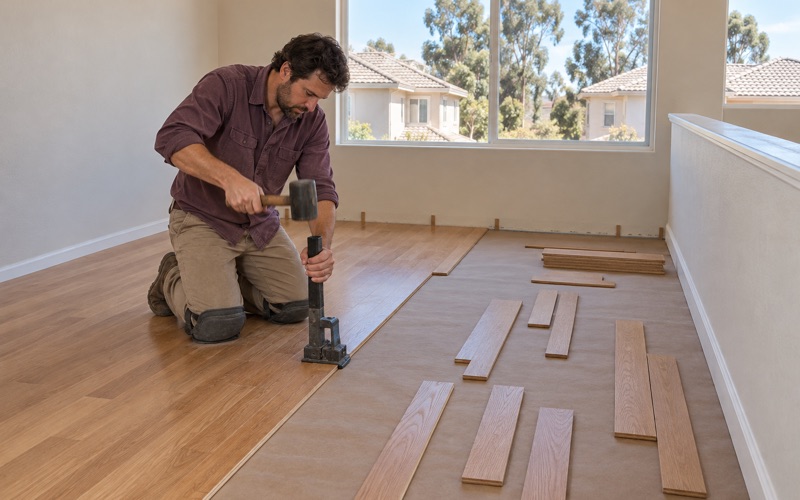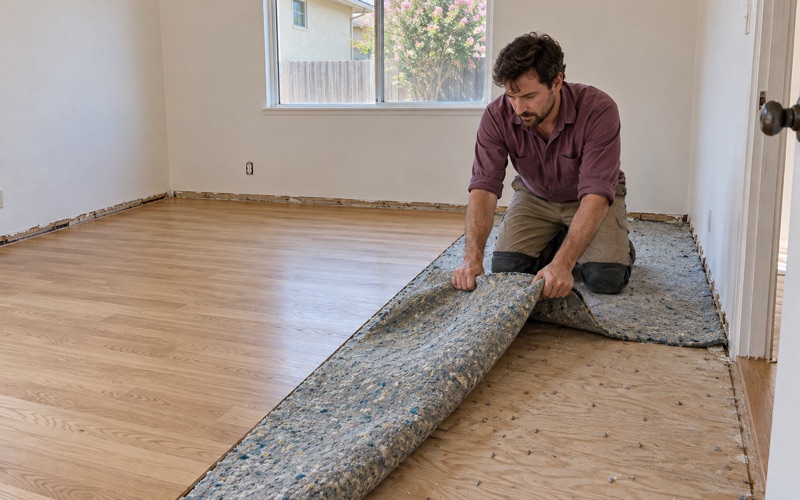
Upland Wood Flooring has handled wood-flooring in Chino for more than 20 years, and the first thing we want to know about any job here is simple: when was the house built? The answer sorts most Chino floors into one of two very different jobs, and it shapes the estimate before a single board is sanded.
An older house may carry decades of refinishing history, with boards that have been sanded more than once and finishes layered over each other. A newer house is often on its first set of floors, where the questions turn to how the original installation was done and what the factory finish can still take. We price and plan those two jobs differently.
Our crews refinish, repair and install solid hardwood and engineered floors, and we work on stairs, water-damaged rooms and floors in rentals between tenants. Every job gets dust containment and a written cure schedule, so a Chino household knows which rooms are off limits and for how long before the first sander is carried through the door.
Which Building Wave Your Chino House Belongs To
The census count for Chino splits almost evenly between old and new. Of the city’s 28,188 housing units, 10,608, or 37.6 percent, were built before 1980, and 10,800, or 38.3 percent, were built in 2000 or later, according to the ACS 2024 five-year estimates. The 1980s and 1990s fill the smaller middle, which is why the build year usually settles our approach quickly.
The 1970s, Chino’s Biggest Decade
No decade accounts for more of Chino’s standing housing than the 1970s, with 5,970 units, or 21.2 percent of the total. That one decade is more than half of everything built before 1980, so when we talk about an older Chino house, we usually mean one that is now around fifty years old. Houses from before 1960 make up only 8.4 percent of the city’s units.
That age changes the preparation before it changes the floor. A house built before 1978 falls under the EPA RRP rule once painted surfaces such as baseboard or door casing are disturbed, so we confirm the build year before any sanding is scheduled. Given how large the 1970s share is, that check matters for much of the city’s older housing.
The Post-2000 Wave
The other wave is just as large. Chino gained 4,824 units in 2000 through 2009, 4,925 in the 2010s and 1,051 from 2020 on, so 21.2 percent of its homes date from 2010 or later. A house from this wave is often still on the flooring that came with it, and that original finish may never have been sanded or recoated.
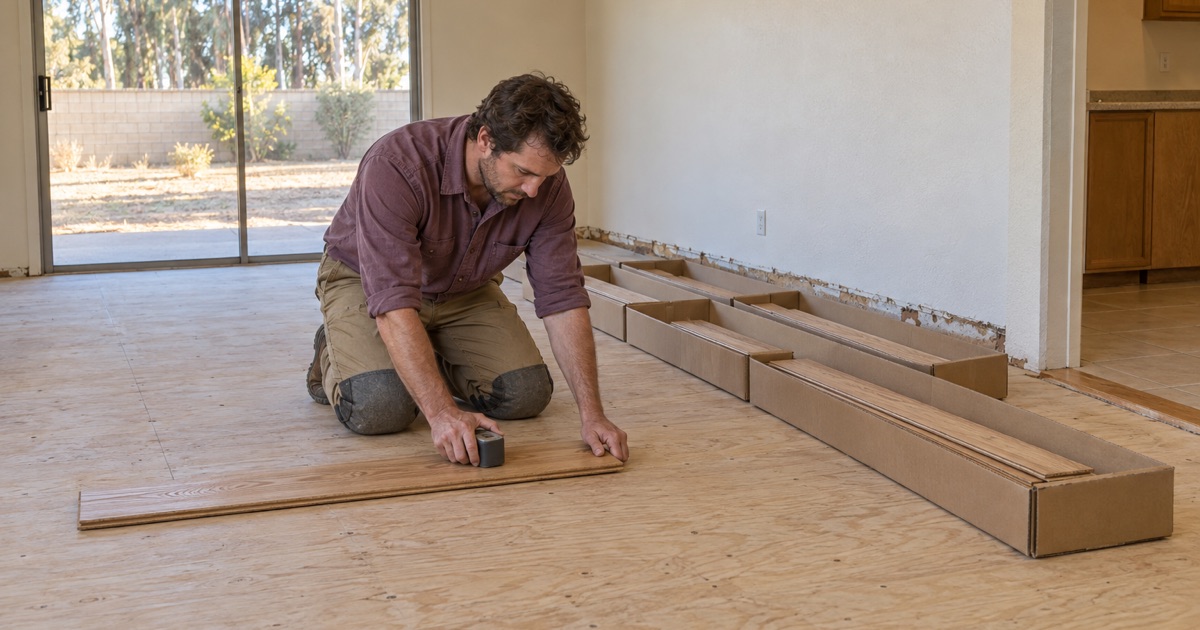
The work on these floors tends to start with identification rather than sanding. We need to know whether the floor is solid hardwood or engineered, whether it was nailed, glued or floated, and, if it came prefinished, what its aluminum oxide finish will accept. Those answers decide whether a screen and recoat, a refinish or a repair makes sense.
When the Year Is Not Obvious
Some houses have been remodeled so thoroughly that the age is hard to read from inside. In that case we look for the date on the property record and check what sits under the current floor at a register or threshold. Knowing the real build year before sanding protects the household. A 1980s or 1990s house sits between the waves and is judged on its own floor.
Looking for wood-flooring closer to Glendora? See Wood-Flooring in Glendora.
Refinishing and Repairing Chino’s 1970s Floors
Reading Fifty Years of Sanding
Solid hardwood from that era was usually milled with enough wood above the tongue and groove to survive several sandings, but every pass takes some of it away. We pull a floor vent or a threshold piece to see the real profile before we recommend a drum sander. If the tongue is close to showing, we steer toward a screen and recoat instead.
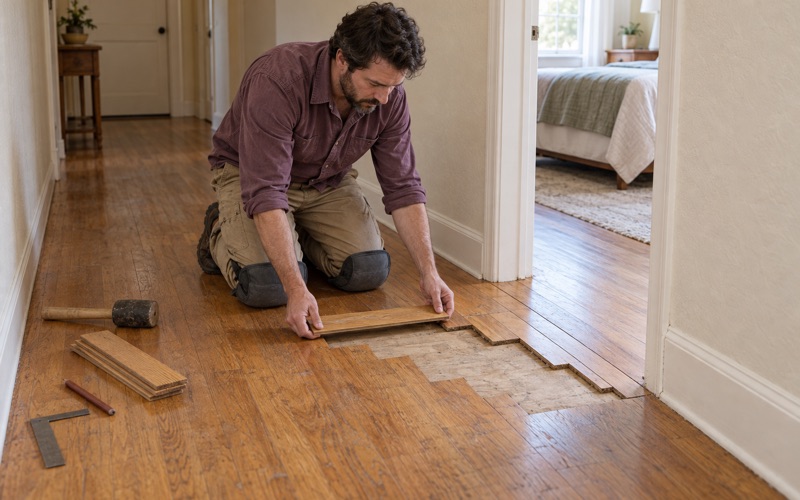
Older floors also carry their history on the surface. Pet urine stains, board gapping that opens in dry months, and patches where a wall once stood are common in houses this age. We repair and match original boards rather than tearing out a whole room, lacing in the same species and width so the patch disappears under the new finish.
Dust, Finish and Air Rules
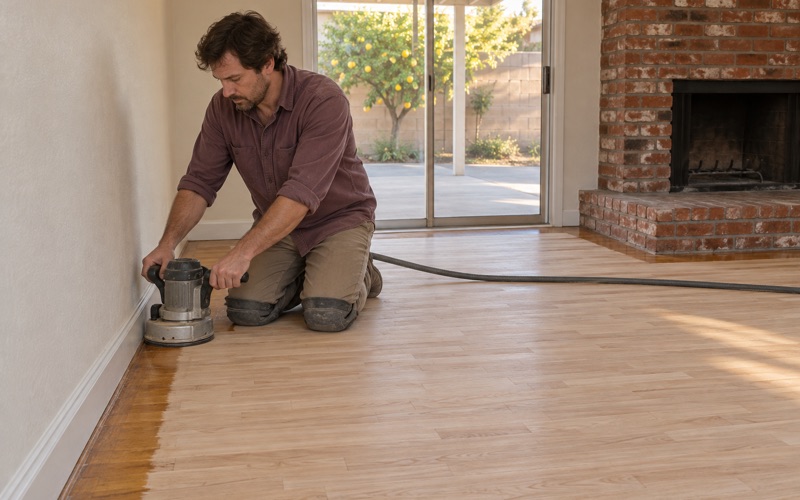
On an older floor we set up dust containment before the drum sander runs, sealing doorways and air returns, then move up the grit sequence before a buffer or orbital sander makes the final pass. Trowel filling or wood filler closes the gaps an old floor develops. When a floor stain is planned, water popping opens the grain so the color takes evenly.
Every finish we apply has to meet SCAQMD Rule 1113, the South Coast AQMD limit on wood coatings, and Chino sits inside that district. We choose between waterborne polyurethane, oil-modified polyurethane and hardwax oil with that limit in mind, pick a sheen level with the owner, and tell the household when furniture and rugs can go back.
Stairs and Original Details
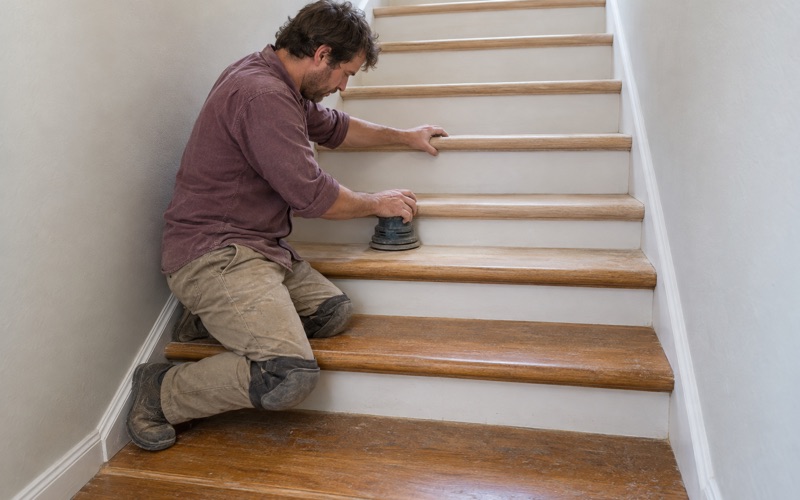
Stairs in an older house can hide under carpet or show the heaviest wear of any wood in the home. We quote stairs by the tread and the riser rather than folding them into a square-foot price, because each step is sanded or replaced by hand and the stair nosing needs its own attention. Pulling an old tack strip leaves nail holes we fill before any finish goes on.
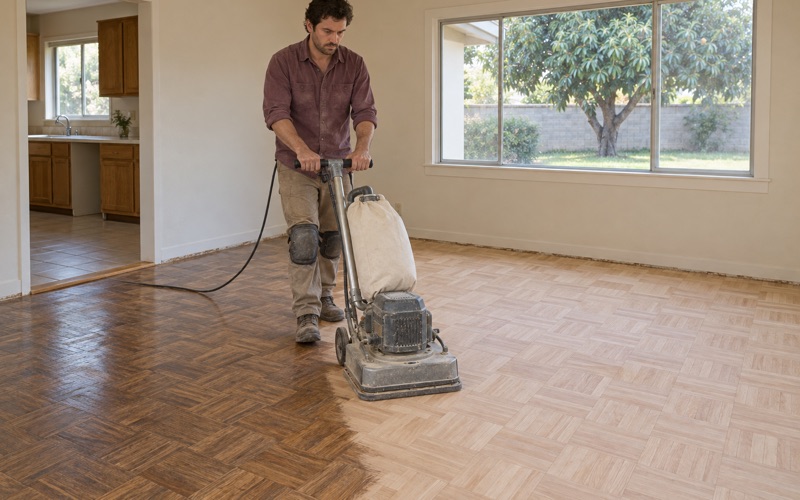
Some older rooms also hide surprises under later coverings, including parquet set in black mastic. Black mastic from that period can contain asbestos, so we do not sand or scrape it until it has been tested. If a room turns up that layer, we stop and explain the options before any work continues. It is one more reason the house’s age is settled first.
Post-2000 Homes and The Preserve
What The Preserve Is
In July 2003 the City of Chino annexed The Preserve, about 5,435 acres of former and existing farm and dairy property. The city places it south of Kimball Avenue, north of State Route 71, west of Hellman Avenue and east of Euclid Avenue. Its plan splits the land roughly in half between development and open space for natural, recreational and agricultural uses.
Former farmland does not tell us anything about a particular floor, and we do not assume it does. The census figures used above are citywide and do not single out The Preserve, so we treat each house there on its own terms: species, construction, installation method and what sits underneath the boards. A newer address alone is not a diagnosis.
Engineered Floors and the Wear Layer
Engineered flooring is common in newer construction, and it looks like solid hardwood until you check the edge. The engineered wear layer is the only part that can be sanded, and it sits on a plywood core or HDF core that cannot. We measure that layer before we promise a refinish, because a thin one may only allow a recoat.
Engineered floors also show their own failures. Delamination, hollow spots under foot and edges that lift can point to an adhesive or installation problem rather than wear. We find the cause before replacing boards, and on a glue-down floor we check whether the adhesive is still holding across the whole room. Tapping the floor maps hollow spots before any cutting starts.
Adding or Replacing Floors Over Concrete
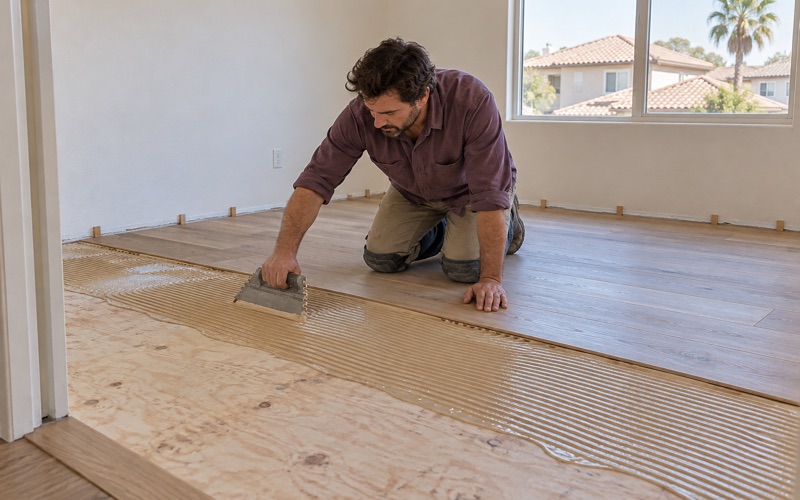
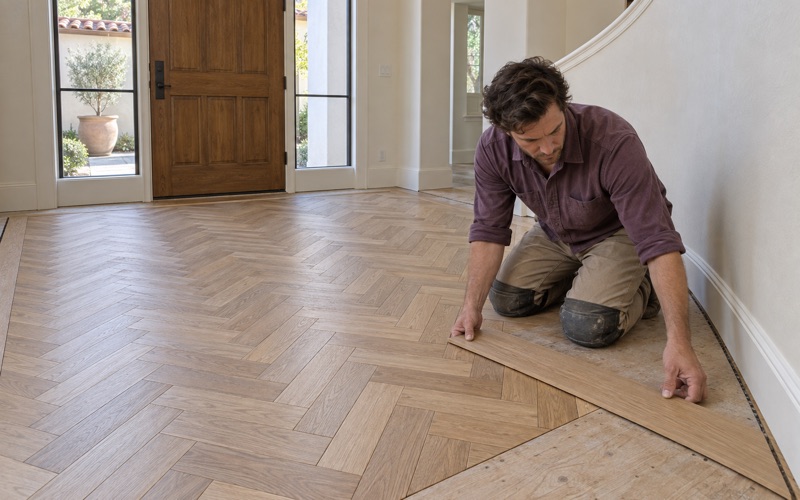
When a newer house is getting new wood flooring, the first question is what the floor sits on. Where it is concrete, we test the slab for moisture before any engineered floor is glued down, using in-situ relative humidity testing or a calcium chloride test, and we write the reading down. Skipping that step is one common way a new floor ends up cupping or buckling.
The reading decides what goes between slab and wood: a moisture membrane, a Class I vapor retarder, or an adhesive system rated for the condition. Where a wood subfloor is involved instead, we check it with a moisture meter and allow acclimation before a nail-down installation with flooring cleats or staples. Either way, the method follows the measurement.
Apartments, Complexes and Attached Homes
Chino households are 64.0 percent owner-occupied and 36.0 percent renters, and a sizable share of those renters live in large buildings. Floors in shared housing move on a different clock than floors in a detached house, set by a lease turnover or an association calendar rather than by a family’s own plans. We schedule around that clock.
Rental Units Between Tenants
Of Chino’s 9,809 renter households, 1,762, or 18.0 percent, live in buildings of fifty or more units, according to the same ACS release. In complexes that size, a floor job usually has to fit inside the gap between one tenant moving out and the next moving in, often with the unit above or below still occupied.
For those turnovers we favor work that keeps downtime short: a screen and recoat where the finish allows it, spot repairs to stained or damaged boards, and prefinished replacement pieces when a section is past saving. If a replacement floor goes into a stacked unit, the building’s own rules on acoustic underlayment come from the owner or manager, not from us.
Townhomes and Condos Their Owners Live In
Attached homes are a smaller but real part of the owner market. The census counts 1,605 owner households in one-unit attached structures, 9.2 percent of the city’s owner households, and a home like that may sit under an association with its own flooring rules. We check those rules and any required approvals before a single box of flooring is ordered.
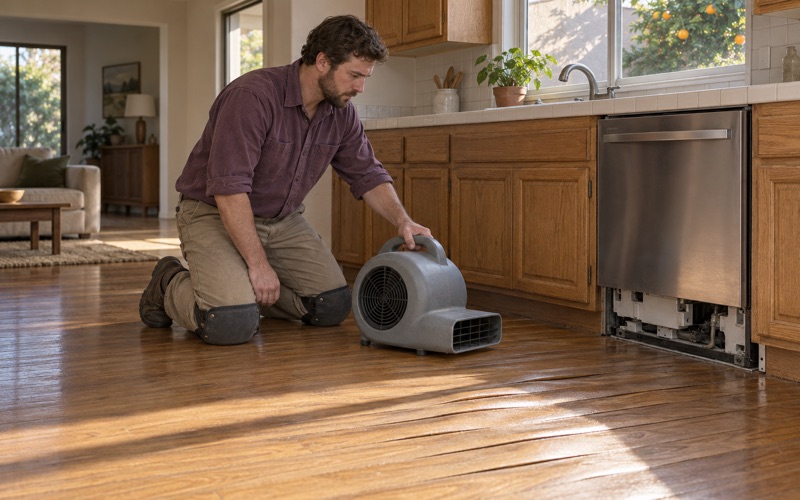
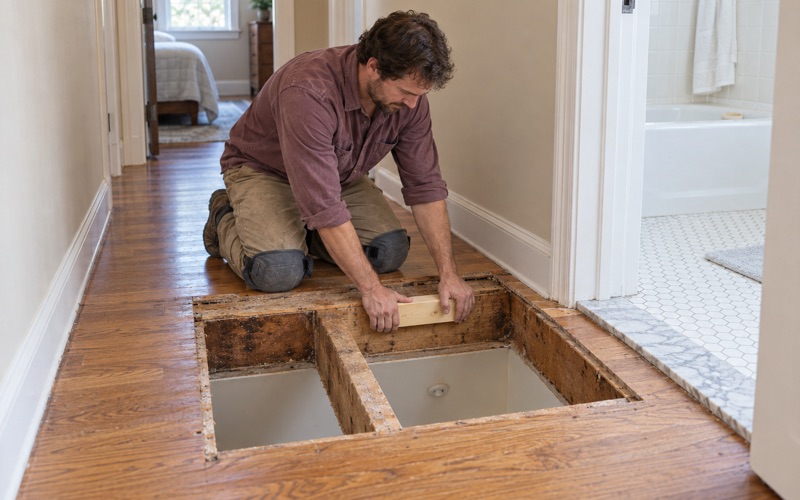
Inside the unit, the work is the same as in a detached house, only with tighter logistics. When water from a shared line or a slab leak reaches the floor, we confirm the leak source and take a moisture reading before replacing boards, and we document the damage room by room for the adjuster. Transitions to shared areas get a proper reducer or T-molding.
- 20+ Years in Wood Floors
- Build Year Checked First
- Written Cure Schedules