
Upland Wood Flooring handles hardwood floor restoration in Upland, CA and has more than 20 years of wood floor experience, serving surrounding cities including San Antonio Heights, Claremont, Montclair, Rancho Cucamonga and La Verne. We bring original floors in older houses back into service by repairing damaged boards, matching what has to be replaced and refinishing the whole floor with care.
Restoration is more than a refinish. An older floor may carry decades of patches, water marks, insect damage, loose boards and past sandings, all of which have to be dealt with before a new finish goes on. The goal is a floor that looks like itself again, not like a new floor laid in an old house.
Upland has a large share of older homes. More than half of the city’s housing was built before 1980, and just under 5 percent before 1940. Many of those houses still have original solid hardwood that is worth keeping.
Assessing an Older Floor
How Much Wood Is Left
The first question on any restoration is how much wood remains above the tongue and groove. A floor sanded several times over the decades has less to give, and a heavy sanding could reach the tongue and ruin the boards. We measure at a floor register or threshold before quoting.
That measurement shapes the whole plan. A floor with plenty of wood can take a full sanding to remove deep damage, while a thin one needs the lightest cut that still gives a clean surface. We say plainly when a floor cannot safely take another full sanding.
Build Year and Painted Surfaces
In older houses, painted baseboards, shoe molding and stair trim are common, and some floors were painted over at some point. The EPA RRP rule covers paint disturbed in homes built before 1978, so we confirm the build year before any sanding.
Where painted surfaces will be disturbed, the work follows lead-safe practices with containment and careful cleanup. Knowing this at the start means the job is planned correctly rather than stopped halfway through.
Insects, Moisture and the Subfloor
Older floors have had time to collect problems below the surface. We look for drywood termite frass, powderpost beetle holes, past water damage and soft or loose subfloor. A moisture meter reading on suspect areas tells us whether a problem is old and dry or still active.
Active insects are treated by a pest professional before we restore anything, and active leaks are repaired first. Once the cause is dealt with, damaged boards and subfloor sections can be replaced so the restored floor sits on a sound base.
Repairing and Matching Original Boards
Keeping the Original Floor
Our approach on older floors is to repair and match rather than replace wholesale. Old-growth boards in older houses are often dense and stable, with a grain and color that new material does not easily match. Keeping them keeps the character of the house.
Damaged boards are cut out and replacements are woven in with staggered end joints, the way the floor was originally laid. After sanding and finishing the whole floor together, a woven repair blends in where a square patch would stand out.
Sourcing Matching Boards
Matching an older floor means matching species, width, thickness and cut. Plain sawn, rift sawn and quartersawn boards show different grain, and older floors often used widths and thicknesses that are no longer standard. We source boards to match or mill them to size when needed.
The best match is often in the house itself. Boards taken from a closet or from under a built-in cabinet have aged the same way as the rest of the floor. We move them into the visible repair and put new boards in the hidden spot.
Patches, Gaps and Old Repairs
Older floors often carry past repairs that did not blend well: boards of the wrong species, filled holes from old heating grates or plumbing, and patches where a wall was moved. We decide case by case whether to rework an old repair or leave it as part of the floor’s history.
Gaps that have opened between old boards can be filled with wood filler or with slivers of matching wood glued in place. Seasonal gaps that open and close with humidity are left alone, since filler in those gaps cracks out.
Refinishing a Restored Floor
Careful Sanding
Sanding an older floor calls for a lighter hand than sanding a new one. We use a grit sequence that removes damage and old finish without cutting deeper than needed, and we check the surface between passes. The edges are sanded carefully so they match the field.
Floors that were painted, covered with adhesive or carpet pad, or finished with wax need extra preparation before sanding. Those residues clog sandpaper and can leave the floor uneven if they are not removed properly first.
Finishes Suited to the House
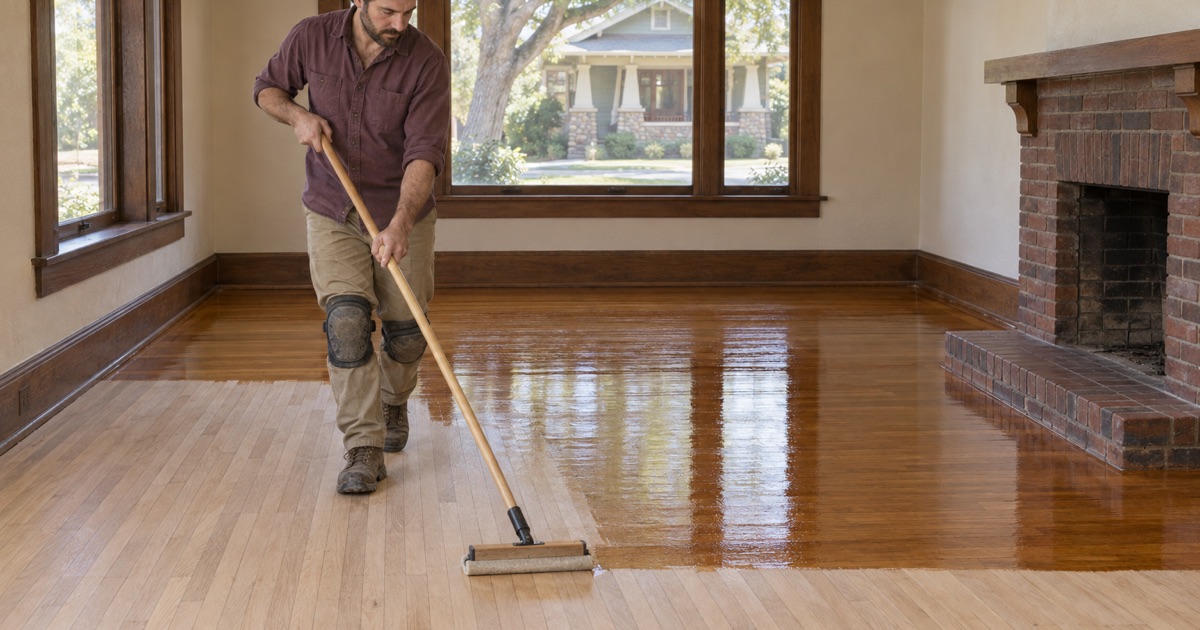
For a restored floor, the finish should suit the age and style of the house as well as how it is used. Oil-modified polyurethane gives a warm, amber tone many older homes were originally finished with. Waterborne polyurethane keeps the wood lighter, and hardwax oil gives a low-luster look that can be spot-repaired later.
Every finish we use is chosen to meet South Coast AQMD Rule 1113 for wood coatings. We show you samples on your own floor and help you choose a sheen level that suits the rooms.
Restoration in Historic Homes
Upland’s Historic Districts
Upland has nine designated historic districts, including Arrow/Laurel Bungalow, Old Magnolia, Old Town and Euclid Avenue. The city’s Certificate of Appropriateness covers exterior modifications, so interior floor restoration usually falls outside it. We check with the city whenever a job reaches the outside of the house.
Many owners in these districts want the floor to match the period of the house. We match species and board widths, avoid modern-looking stains unless requested, and keep original boards wherever they can be saved.
Mills Act Properties
Some historic properties in Upland are under Mills Act contracts, which carry a work plan agreed with the city. If your floor restoration is part of that plan, we provide a clear written scope of the work and the materials so it can be matched against your commitments.
- 20+ Years in Wood Floors
- Build Year Checked First
- Written Cure Schedules