Upland Wood Flooring brings more than 20 years in the trade to wood-flooring in Lytle Creek, and a canyon house asks for a slower first visit than a newer tract home does. We look at the boards, the finish history and the rooms around them before we name a method, because an older floor usually tells us what it can take.
Most requests we see fall into four jobs: sanding and refinishing solid hardwood, repairing and matching original boards, installing new solid or engineered floors, and replacing boards after a leak. Each one starts with a moisture meter reading and a look at the subfloor from wherever we can reach it, because we would rather measure a floor than assume anything about it.
Before any work begins, you get a written scope that names the dust containment, the finish product and a cure schedule showing which rooms are off limits and for how long. Stairs are priced by the tread and riser rather than buried in a square-foot figure, so the quote reads the way the job will actually be done.
Floors in Lytle Creek’s Canyon Houses
A Community Inside the National Forest
Lytle Creek is an unincorporated census-designated place in the San Gabriel Mountains, and it sits completely within the boundaries of the San Bernardino National Forest. There is no city government here, so building questions go to San Bernardino County’s Land Use Services Department rather than a city hall. We keep that in mind from the first call, because the county is the authority a homeowner deals with.
A home ringed by national forest also changes the logistics of a job. Material, sanders and finish all come up the canyon road in one planned trip where possible, and we stage them so a driveway stays usable. At about 3,419 feet, the community sits well above the valley floor where most of our supply runs start.
Detached, Owner-Occupied Homes
Housing here is almost entirely single-family detached, about 98.5 percent of units, and roughly 96 percent of occupied homes are lived in by their owners. That combination changes how we plan. With no attached or multi-unit housing counted, the condo-association step we run elsewhere seldom enters the picture, but there is almost always a family living in the house while the floor is open.
So we sequence rooms to keep a kitchen and one bathroom reachable, seal doorways with dust containment, and write the cure schedule around the household rather than around our calendar. Waterborne polyurethane lets most rooms return to light foot traffic sooner than an oil-modified finish, which is often the deciding factor for an owner who never moved out.
Choosing Between Refinish and Replace
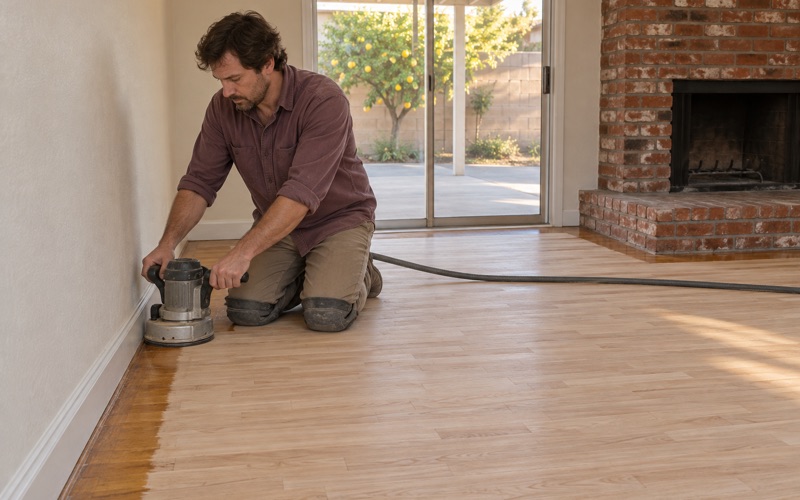
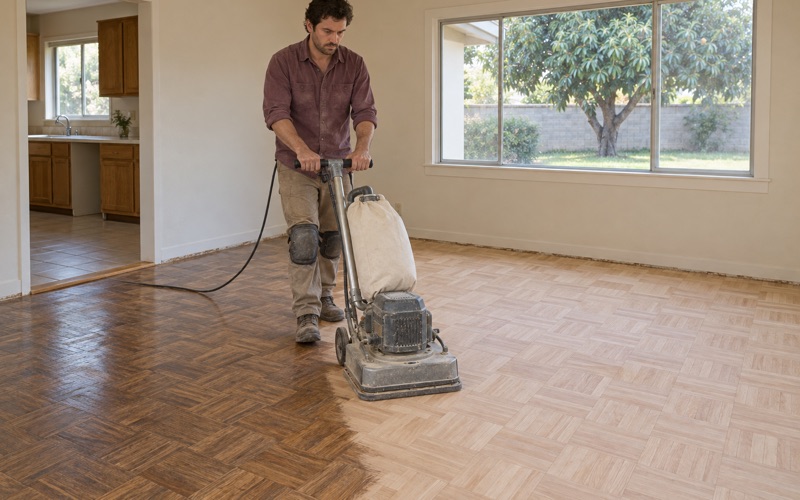
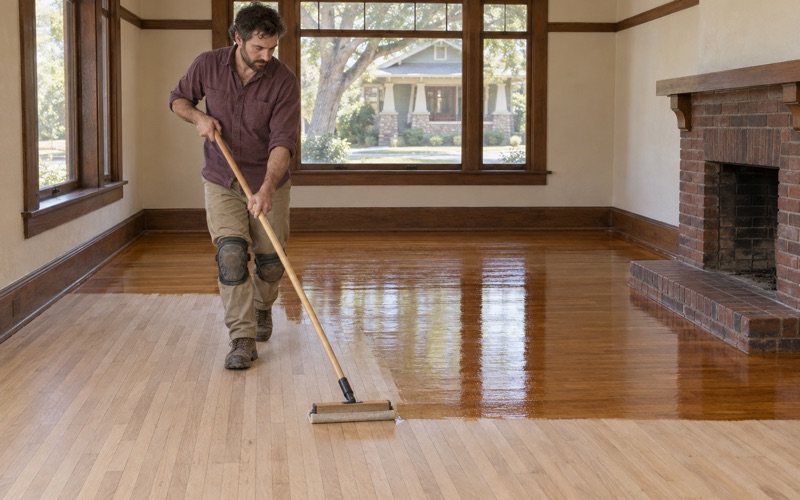
Solid hardwood in an older house can usually be sanded several times, and we check the thickness above the tongue and groove before promising a full drum sander pass. On an engineered floor, we measure the engineered wear layer first, since a thin veneer over a plywood core or HDF core cannot survive an aggressive grit sequence.
Pet urine stains are the other common deciding factor. Light surface marks often sand out, but deep black stains usually mean replacing those boards, and we say so before the sanding starts. Water popping before a floor stain goes on helps new and old boards take color evenly.
Looking for wood-flooring closer to Citrus? See Wood-Flooring in Citrus.
Homes From the 1940s Through the 1960s
What the Census Count Shows
The Census Bureau’s latest five-year estimate counts roughly 333 homes in Lytle Creek, and the 1940s are the single largest build decade, at about 27 percent of that stock. About 43 percent were built before 1960, and the 1960s added another sizable group. The sample is small, so we treat those shares as a rough picture rather than a precise one.
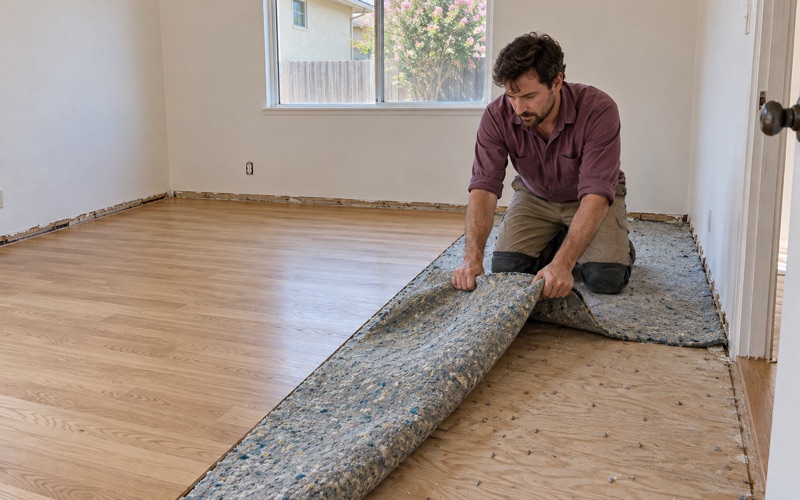
For a flooring job, that age profile means many floors have likely been refinished, patched or covered more than once. In houses of that era, red oak or white oak strip flooring often turns up under carpet, with tack strip holes along the walls, and sometimes black mastic sits under old tile. Each of those changes the prep before sanding starts.
Lead-Era Paint and Old Mastic
With so much of the stock built before 1978, we confirm a house’s build year before any sanding. The EPA RRP rule reaches painted surfaces disturbed in pre-1978 homes, and baseboard, quarter round and stair risers are often painted trim that a floor job touches. Knowing the year up front decides how we set containment and cleanup.
Black mastic from older tile is a separate concern, since some older cutback adhesives contained asbestos. We do not sand or grind it without knowing what it is. When mastic shows up under a floor covering, we stop, explain what testing involves, and plan the rest of the job around the result.
Repairing Original Boards
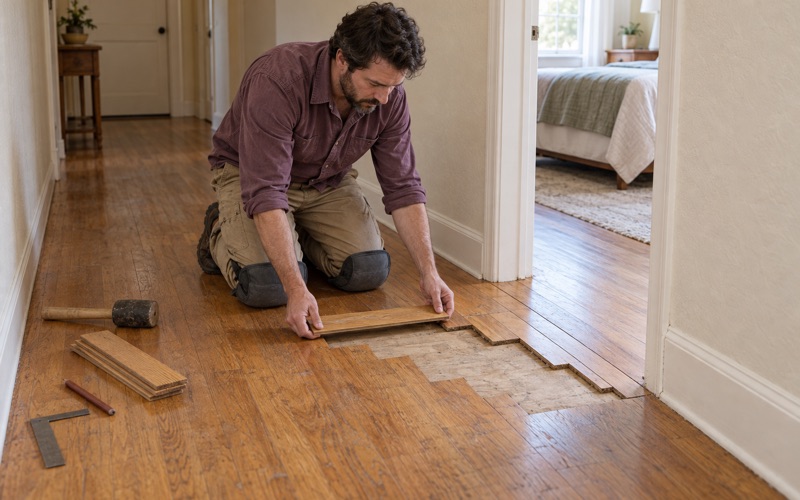
Where original boards are worn but sound, we repair and match rather than tear out a whole room. That means sourcing strip flooring in the same species and width, weaving new pieces into the old run, and blending stain across the patch. A well-matched repair keeps the character of a mid-century floor that a full replacement would lose.
Older wood also shows problems newer floors rarely have. We check for powderpost beetle exit holes and drywood termite frass before patching, because a repair laid over active insects fails. Board gapping between strips is often seasonal and harmless, and we explain the difference between that and a gap that points to a structural or moisture issue.
Wood Floors in a Mountain Forecast Zone
A Different Zone From the Valley
The National Weather Service places Lytle Creek in its San Bernardino County Mountains forecast zone, CAZ055, the same zone that covers Big Bear Lake. A point in Upland, down in the valley, falls in a different zone, CAZ048. For a wood floor, that distinction matters because conditions up the canyon are forecast separately from the city below.
Rather than lean on general assumptions about mountain weather, we take readings on site. A moisture meter on the boards and subfloor, plus a check of indoor conditions over the visit, tells us more about a specific house than any regional generalization. Those numbers go into the written scope.
Acclimation and Installation Method
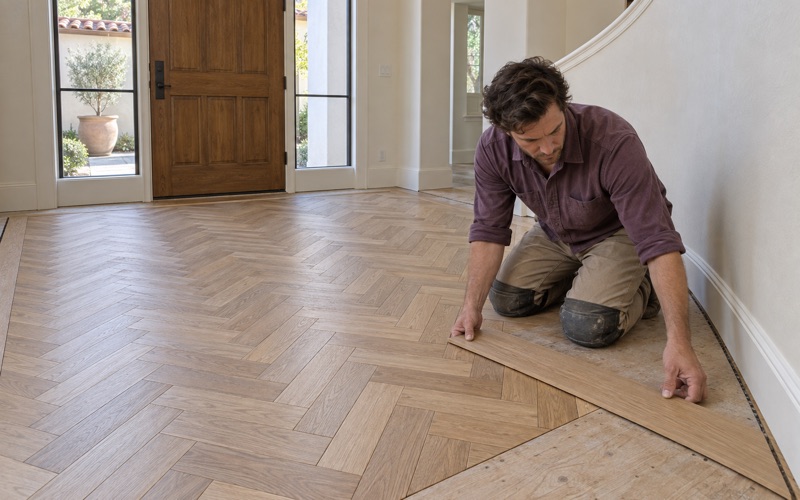
New flooring gets acclimation time in the house before it goes down, and we check that the boards and subfloor are within the range the NWFA Installation Guidelines call for. Delivering material up the canyon a few days early is part of that plan, so the wood settles toward the home’s own conditions rather than a warehouse’s.
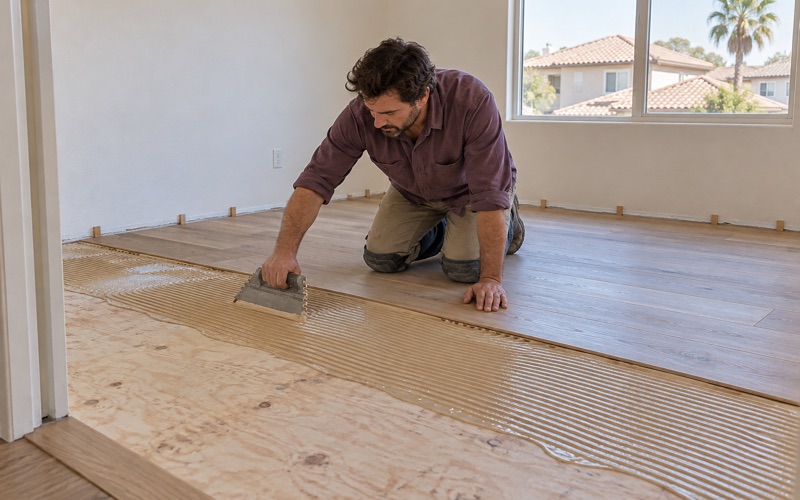
Nail-down installation with flooring cleats suits a wood subfloor over floor joists, while a glue-down installation with urethane flooring adhesive is the usual route over concrete. We do not assume which one a house has; we look. If there is a slab, it gets moisture testing, such as in-situ relative humidity testing, with the reading written down before an engineered floor is glued.
Species and Finish Choices
For a busy household with dogs and boots coming in from outdoors, species hardness is worth weighing. Hickory and maple rank higher on the Janka hardness scale than red oak, and white oak is a steady middle choice that takes stain evenly. Wide plank boards look right in many older rooms but move more with seasonal change.
On finish, we choose products that fit South Coast AQMD Rule 1113 limits for wood coatings. The district appears to cover this part of the county, as it does the other non-desert areas, and we confirm the rules that apply to the address before ordering. A low-sheen waterborne polyurethane or a hardwax oil hides trail dust better than a gloss.
After the Blue Cut Fire: Planning Canyon Floor Work
What the 2016 Evacuations Meant
The Blue Cut Fire started on August 16, 2016, in the Cajon Pass, and it brought mandatory evacuation orders to Lytle Creek. Wrightwood, Lytle Creek and the West Cajon Valley together had about 3,198 structures threatened. The orders for Lytle Creek were later reduced to voluntary, with residents allowed back past the closures at Sierra Way and Lytle Creek Road and at Glen Helen Parkway.
We make no claim about which homes here were affected, and fire cleanup is only one small part of our work. What an evacuation does show is that a house can be closed up in a hurry and left empty for a while. If smoke or ash reaches the floors, we document water, smoke and ash damage room by room so an adjuster has a clear record.
Leaks and Water Damage
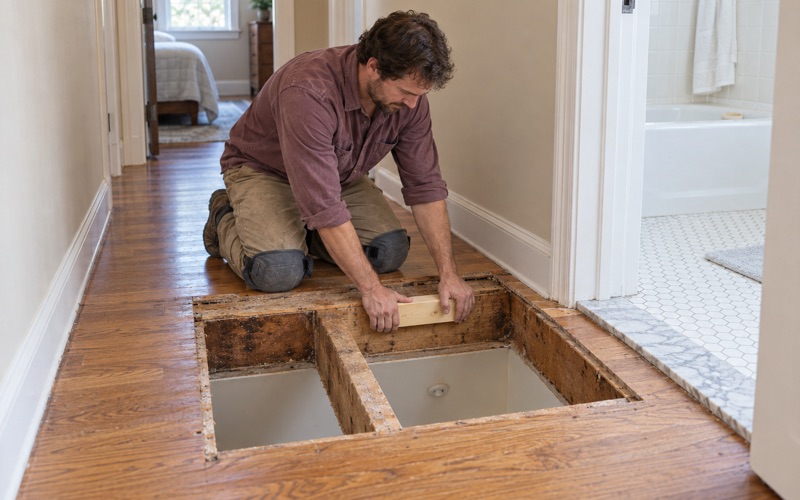
Water is a more common reason a floor needs boards replaced. Before we pull anything, we confirm the leak source is fixed and take moisture meter readings across the wet area and beyond it. Cupping, crowning and buckling each point to a different moisture pattern, and replacing boards before the source is stopped only repeats the damage.
A cupped floor that dries out can sometimes be sanded flat later, which is cheaper than replacement. Sanding too early, while the boards are still wet, can leave them crowned once they finish drying. We tell you when waiting is the better call, and we write down the readings so the decision is based on numbers rather than guesswork.
Scheduling a Job Up the Canyon
The community was settled in 1851, the stream is named for Captain Andrew Lytle, and the canyon has drawn visitors as a recreation area since the early 1870s. For a crew coming up from the valley, the practical point is simple: we bring what the job needs. Dustless sanding equipment and a buffer ride along, so a screen and recoat can often finish in one visit.
Transitions such as a reducer, T-molding or new quarter round are listed as their own line items rather than hidden in the total. Once the scope is set, we walk you through the order of rooms, so you know which evening the bedrooms open again and when furniture and rugs can safely return.
- 20+ Years in Wood Floors
- Build Year Checked First
- Written Cure Schedules